Okinawa Compass
Building an Okinawa Travel Content Strategy with SEO, UX, and WordPress
How a simple SEO learning project evolved into a live website shaped by search intent, analytics, and user experience.
Case Study Navigation
Project Overview
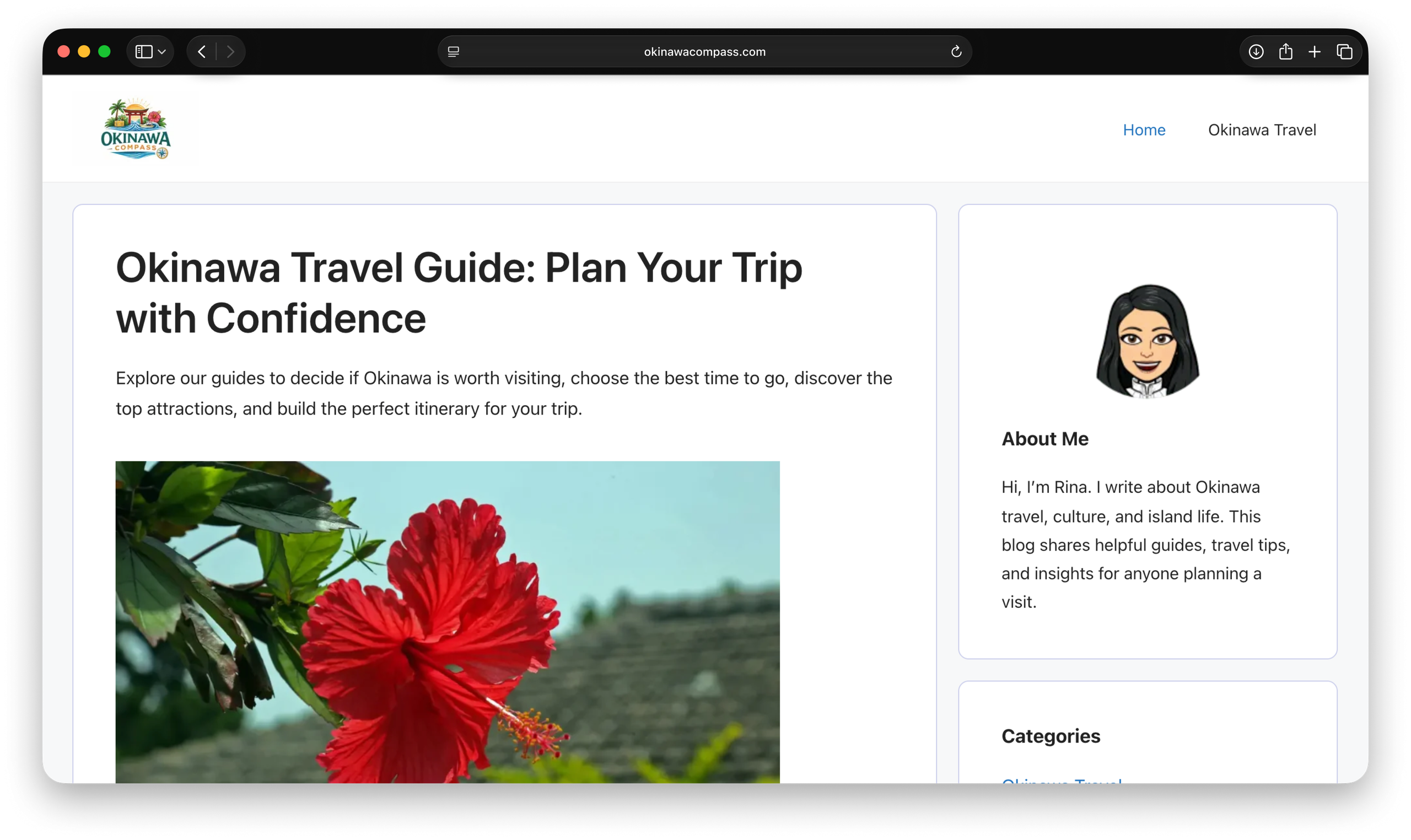
Okinawa Compass is a travel website focused on helping visitors plan trips to Okinawa, Japan. The site provides practical travel guides covering topics such as when to visit, what to do, how to plan an itinerary, and other common traveler questions. View the live Okinawa Compass website.
I created Okinawa Compass to gain hands on experience with SEO, content strategy, analytics, user experience, and WordPress website management while working on a live website.
The first article launched in March 2026, and additional articles were added as the content strategy evolved. This allowed me to monitor search performance, analyze user behavior, and refine both the content and user experience using real world data.
As I researched travel topics and reviewed competing content, I realized the project involved much more than identifying keywords. Understanding how travelers discover, navigate, and use information became just as important as identifying the right search opportunities.
“What information do travelers need next, and how can I make it easier to find?”
That question became a guiding principle for the project. What started as a way to build practical SEO experience evolved into an ongoing WordPress project where I could apply research, test ideas, analyze performance, and continuously improve the website over time.
My Contributions
- SERP & Competitor Analysis
- Keyword Research
- Content Gap Analysis
- Content Strategy
- On-Page SEO
- Internal Linking
- Technical SEO
- WordPress Management
- Analytics & Performance Analysis (GA4 & Search Console)
Tools Used
- WordPress
- Google Search Console
- Google Analytics 4 (GA4)
- Screaming Frog SEO Spider
- SEMrush
- Moz
- Rank Math
- PageSpeed Insights
- SiteGround
Technologies
- HTML
- CSS
- PHP
The Discovery: Looking Beyond Keywords
When I started Okinawa Compass, I expected to spend most of my time researching keywords, tracking rankings, and creating content.
As I reviewed search results and competing travel guides, I noticed something unexpected. Many pages contained useful information, but they were often difficult to scan, poorly organized, or missing clear trip planning guidance.
Some of the most common issues included:
- large blocks of text
- weak heading hierarchy
- cluttered layouts
- limited planning resources
- confusing organization
As I continued researching, I realized that travelers were not simply searching for information. They were trying to answer specific questions, make decisions, and move from one stage of trip planning to the next.
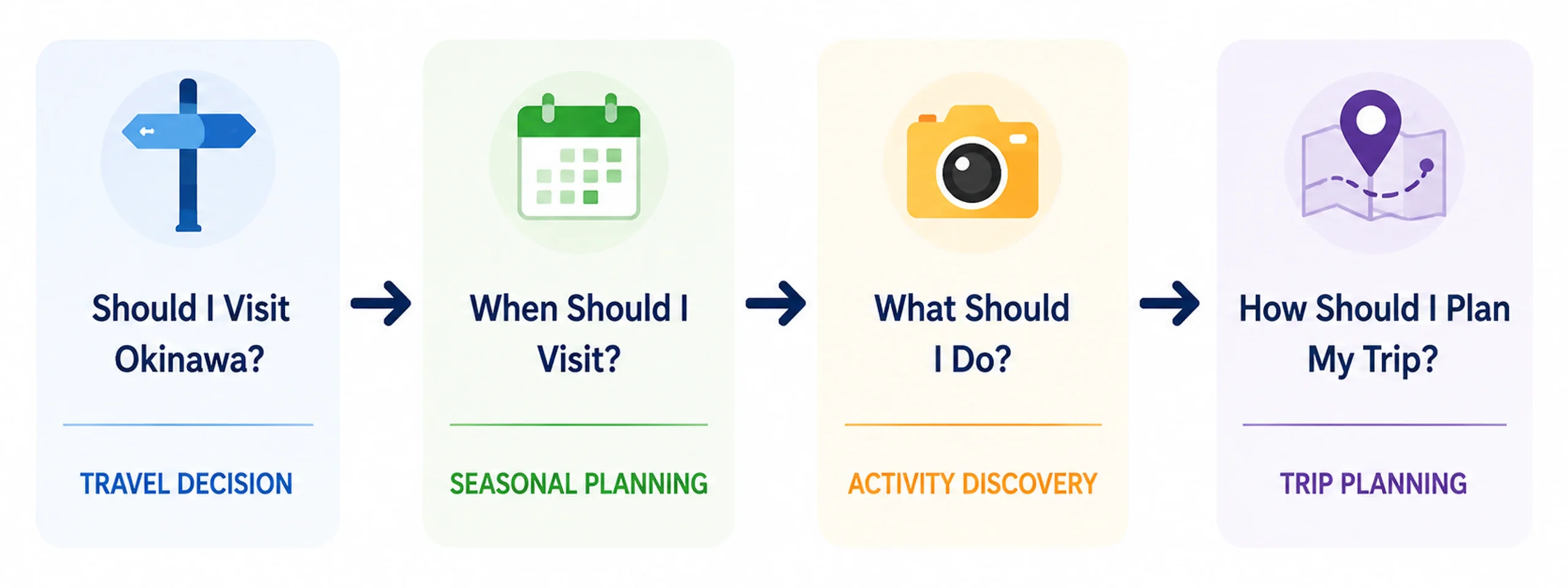
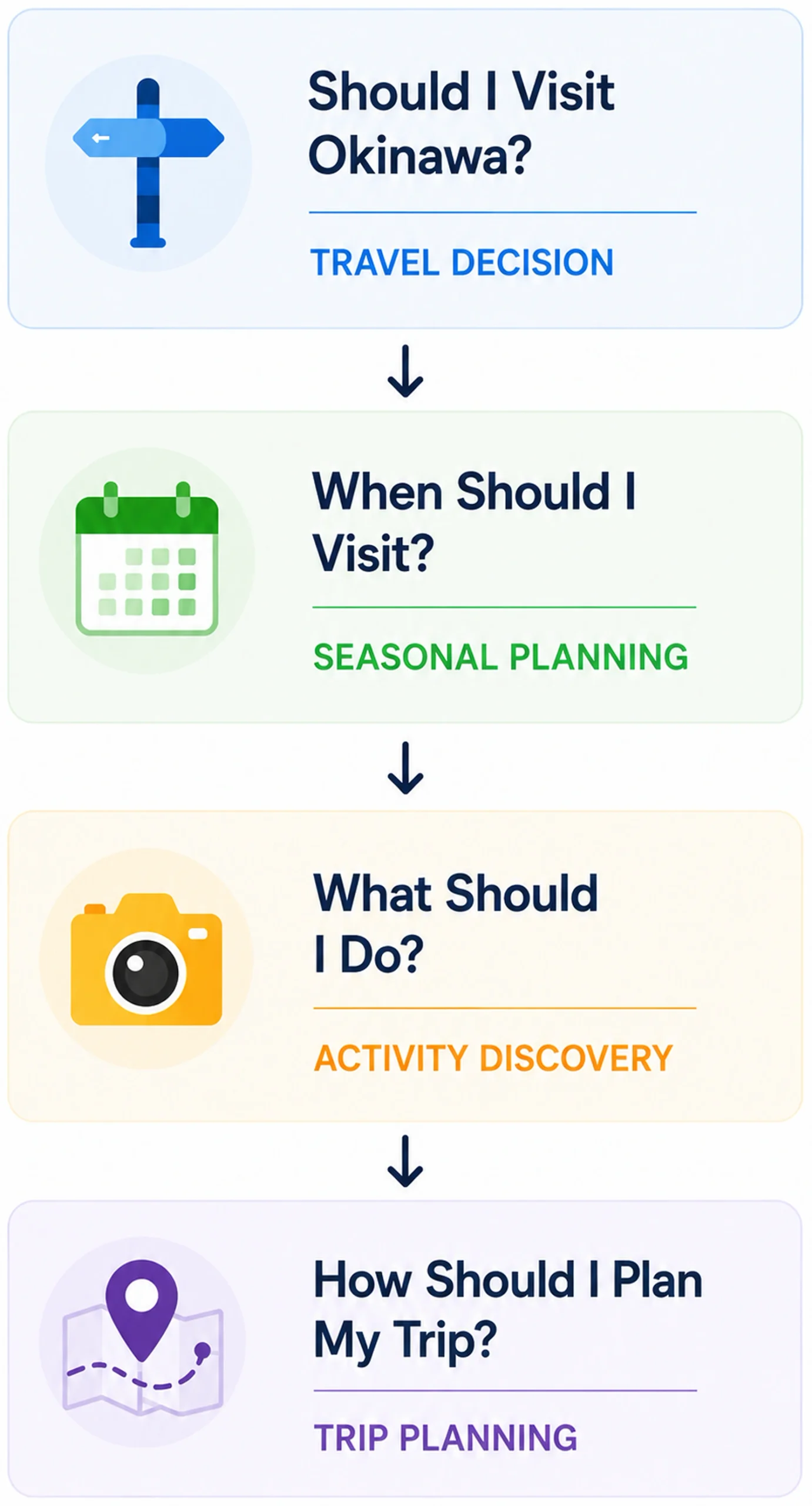
The research revealed a natural progression in traveler intent: deciding whether to visit, choosing when to go, discovering what to do, and planning the trip itself.
That shifted my focus beyond individual keywords and toward understanding search intent, the traveler journey, and the overall user experience.
These insights became the foundation for the site’s content strategy, internal linking structure, and ongoing optimization efforts, with each article designed to support a different stage of the travel planning journey.
Understanding Search Intent and Traveler Needs
After identifying the broader traveler journey, I reviewed search results more closely to understand what users expected to find and what types of content were already performing well.
Rather than starting with keyword tools, I analyzed:
- Search intent
- Competing content
- SERP features
- Content depth
- Common UX patterns
- Traveler questions and concerns
One of the strongest patterns was the presence of both traditional travel guides and discussion based content from Reddit and other travel communities. This suggested that travelers were often looking for more than factual information. They also wanted reassurance, opinions, and help making travel decisions.
As I compared topics, I found that different searches reflected different stages of the travel planning process. Instead of treating every keyword as an isolated opportunity, I began looking for patterns in how travelers researched, evaluated, and planned their trips.
This helped me move beyond individual keywords and begin organizing content around the traveler journey.
Key Research Findings
Common UX & Content Issues
- Poor readability and large blocks of text
- Weak heading hierarchy
- Intrusive ads and popups
- Cluttered layouts and inconsistent formatting
- Limited trip planning resources
- Confusing itinerary organization
- Missing transportation guidance
- Weak or missing FAQ sections
Opportunities Identified
- Create decision focused content
- Improve readability and scannability
- Organize information around traveler needs
- Add practical planning resources and FAQs
- Use internal links to support the traveler journey
Key Takeaway: This research reinforced how closely SEO and user experience work together. The goal became not only to answer search queries, but to create content that helped travelers find information more easily, understand their options, and make informed planning decisions.
From Keywords to Traveler Questions
As I continued researching Okinawa travel topics, I realized that keyword volume alone did not tell the full story.
At first, I expected the highest volume keywords to represent the strongest content opportunities. However, SERP research showed that some of the most useful opportunities were tied to specific traveler questions and decisions, rather than simply targeting keywords with the largest search volumes.
Instead of selecting topics based solely on keyword demand, I focused on the questions travelers were trying to answer:
- Is Okinawa worth visiting?
- When is the best time to visit?
- What are the best things to do?
- How should I plan my trip?
I then used keyword research to validate search demand, evaluate competition, and identify supporting topics that could strengthen each article.
One of the most valuable discoveries came after the website began generating real Search Console data. The queries Google associated with the site did not always match what keyword volume alone would have predicted. Specific seasonal and travel planning questions sometimes generated stronger visibility than expected.
This reinforced an important lesson: search volume is only one part of content strategy. Search intent, competition, content quality, organization, and user experience can all influence how content performs in search results.
As a result, I focused on creating content that was easy to scan, centered on traveler decisions, and organized around the information users needed next.
Key Takeaway: Effective content strategy came from balancing keyword research with search intent, real traveler needs, and performance data rather than relying on search volume alone.
Content Strategy: Mapping the Traveler Journey
As I reviewed search results across multiple topics, I began noticing a pattern. Travelers were not searching for isolated topics, they were moving through a series of connected questions as they planned their trip.
Rather than creating unrelated articles, I organized the site around the traveler journey, with each article supporting a different stage of the planning process.
The content strategy was designed to move from travel decision making to trip organization, creating a natural progression between related topics.
Traveler Journey Content Map
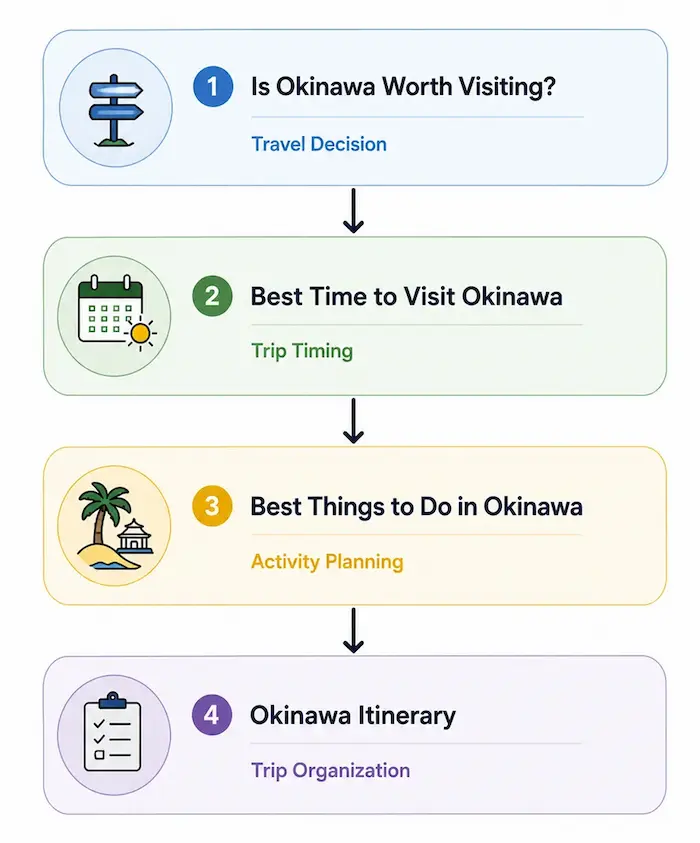
This approach allowed each article to serve a specific purpose while connecting visitors to the next stage of their travel planning journey.
For example, someone deciding whether Okinawa was worth visiting could continue to information about the best time to visit, things to do, and eventually a complete itinerary.
This created a more connected content experience while also providing a logical structure for internal linking and future topical expansion.
As the content strategy evolved, I focused less on individual keywords and more on how information was organized, connected, and presented across the website. This helped bring SEO, content strategy, and user experience together within a single planning framework.
Key Takeaway: Organizing content around the traveler journey, not isolated keywords, created a more connected experience for users while strengthening the site’s overall content strategy and SEO foundation.
Bringing the Strategy to Life in WordPress
After completing the research and content planning process, I began building and optimizing Okinawa Compass in WordPress.
Rather than treating the site as a collection of individual articles, I focused on creating a connected website structure that supported the traveler journey, search visibility, and overall user experience.
Key Implementation Decisions
- Creating clear site organization
- Building internal links between related travel topics
- Applying on-page SEO best practices
- Improving readability through headings, lists, and content structure
- Organizing articles around search intent and trip planning needs
One of the main goals was to help visitors continue their research naturally. Related articles were connected so travelers could move from deciding whether Okinawa was right for them to choosing when to visit, discovering activities, and eventually planning an itinerary.
Internal linking also helped reinforce the relationship between related topics while creating clear pathways for both users and search engines.
Internal Linking Strategy
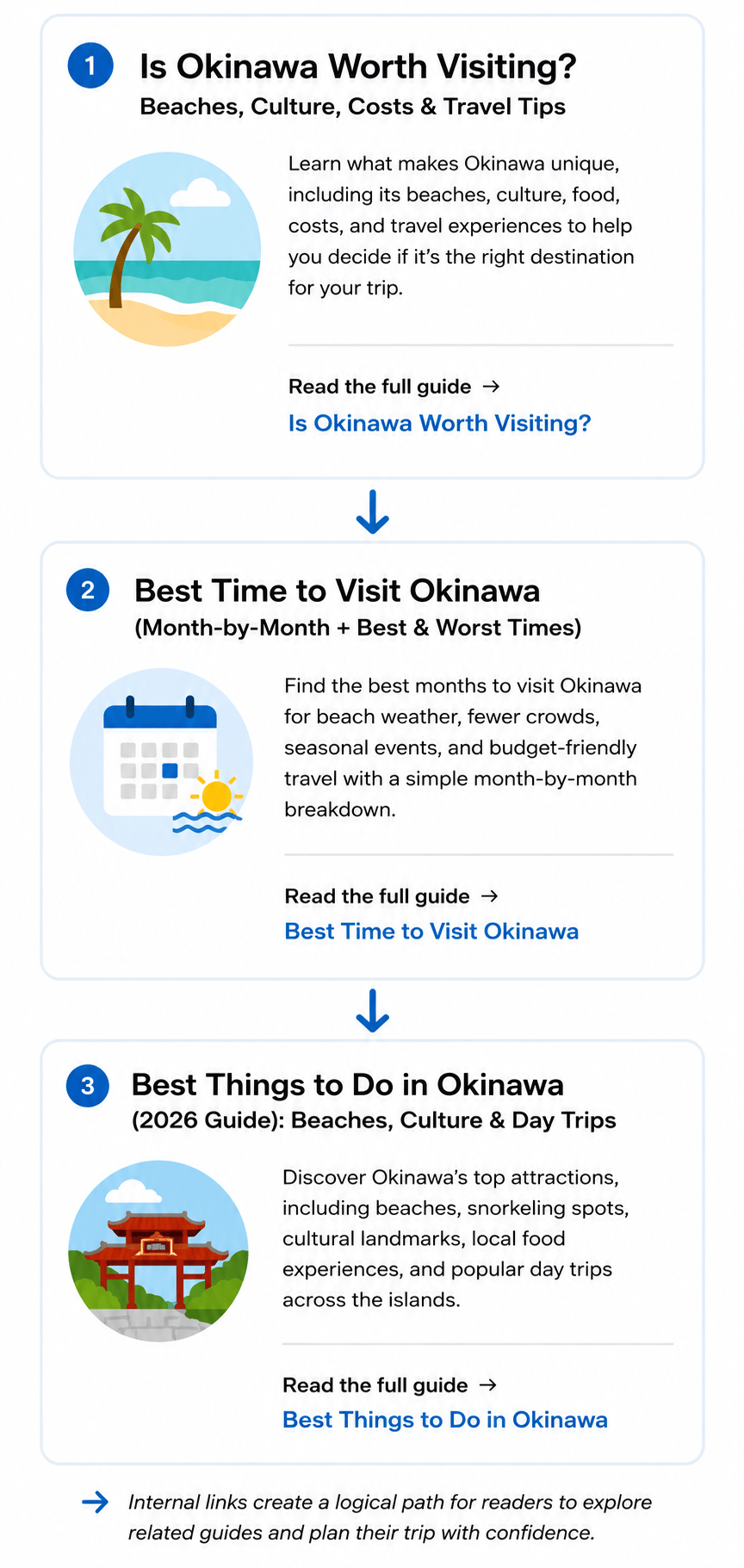
As the site grew, my role expanded beyond content creation into ongoing WordPress management and technical optimization. I monitored site performance, reviewed analytics, troubleshot WordPress issues, and made improvements designed to support both user experience and search visibility.
This gave me hands on experience managing a live website while applying and testing the SEO, content strategy, and UX principles identified during the research process.
Key Takeaway: Building the site in WordPress allowed me to turn research and content strategy into a connected user experience through thoughtful site organization, internal linking, and ongoing SEO improvements.
Performance Optimization & Technical Auditing
As Okinawa Compass grew, performance and technical site quality became an important part of the overall user experience. I used PageSpeed Insights, Screaming Frog, and WordPress troubleshooting to identify opportunities beyond content and on-page SEO.
Performance & Technical Optimization
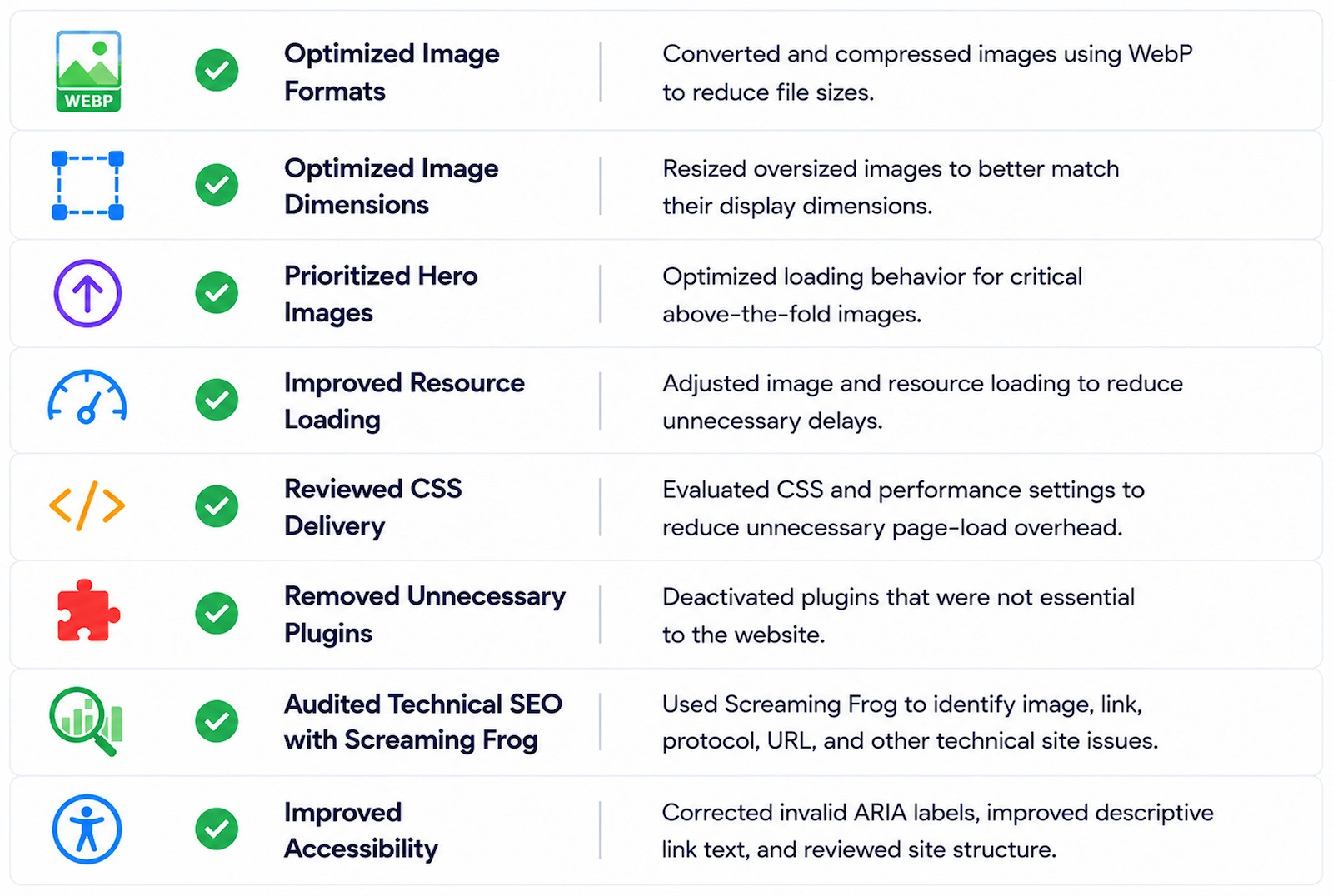
Through testing and optimization, I reduced image file sizes, converted images to WebP, resized oversized assets, optimized hero images, adjusted resource loading behavior, and reviewed SiteGround performance settings to improve how pages loaded for visitors.
I also used Screaming Frog to audit technical SEO and site health, including image optimization, internal links, URL and protocol issues, and other technical elements that could affect crawling, performance, or usability.
Accessibility was reviewed alongside technical SEO. I corrected invalid ARIA labels, improved descriptive link text, and reviewed site structure and image attributes to identify additional opportunities for improvement.
As the project continued, I also gained experience using custom PHP and CSS to troubleshoot WordPress behavior and implement targeted improvements when theme or plugin settings alone were not sufficient.
These efforts helped me understand that website optimization is an ongoing process of testing, diagnosing issues, implementing improvements, and validating results rather than a one time performance task.
Key Takeaway: Performance optimization expanded the project beyond content SEO, giving me hands on experience with technical auditing, accessibility, WordPress troubleshooting, and performance improvements that supported both search visibility and user experience.
Measuring Performance and Learning from Real Data
Once content was published and the site was optimized, I began monitoring performance using Google Search Console and Google Analytics 4.
Rather than focusing only on rankings, I wanted to understand how users discovered the website, which topics gained search visibility, which content attracted visitors, and how users engaged after arriving.
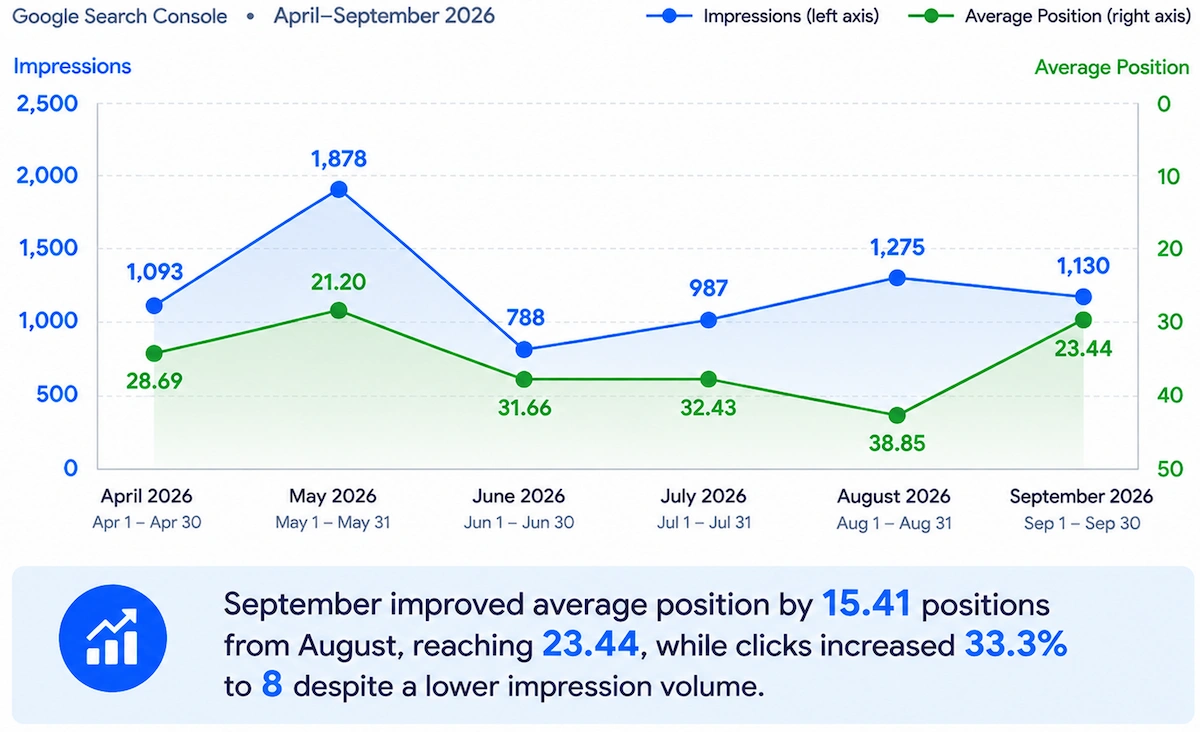
As more data accumulated from April through September, the results showed that SEO performance was not a simple upward line. Visibility, rankings, and traffic fluctuated from month to month as search engines continued testing the site’s content across different queries and pages.
More importantly, the data began revealing which topics search engines associated with the site, how organic discovery differed across search platforms, and where future optimization opportunities existed.
Search Visibility Over Time
Search Visibility Highlights
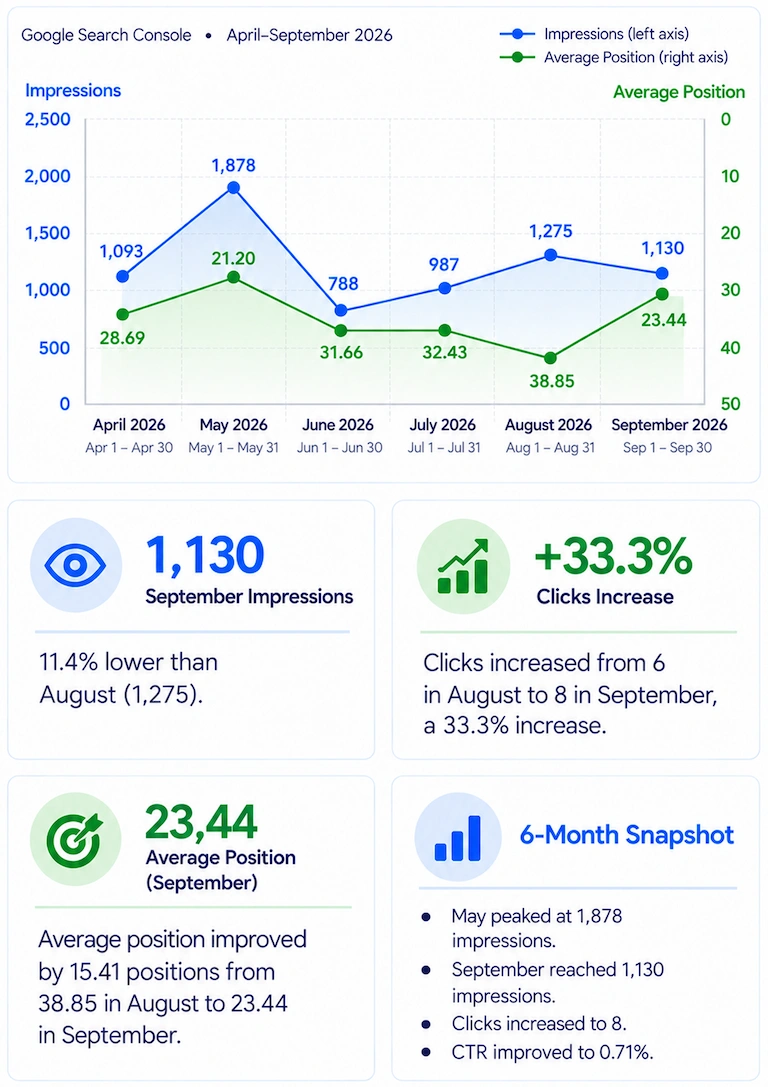
- September generated 1,130 impressions and 8 clicks. Although impressions decreased 11.4% from August, clicks increased 33.3%, from 6 to 8
- Average search position improved substantially from 38.85 in August to 23.44 in September, while CTR increased from 0.47% to 0.71%, showing stronger ranking and click performance despite lower overall visibility
- Best Time to Visit Okinawa remained the site’s strongest source of Google search visibility, generating 848 impressions in September and improving from an average position of 30.34 in August to 17.92
- Search Console revealed growing visibility around travel timing, seasonal planning, and weather-related searches. “Okinawa weather” increased from 4 impressions in August to 51 in September while maintaining an average position near 3, while “best month” and “best season” also showed substantial ranking improvements
- Additional pages showed encouraging ranking gains, including Is Okinawa Worth Visiting?, which improved from an average position of 51.37 in August to 13.5 in September, although traffic to the page remained limited
Search Console continued challenging some of my original keyword assumptions. Queries tied to specific seasonal, weather, and travel-planning questions gained visibility and stronger rankings, reinforcing that real search behavior can reveal opportunities that keyword volume estimates alone may miss.
Looking Beyond Google Search Console
Google Search Console showed how the site was performing within Google, but GA4 revealed a broader organic search story.
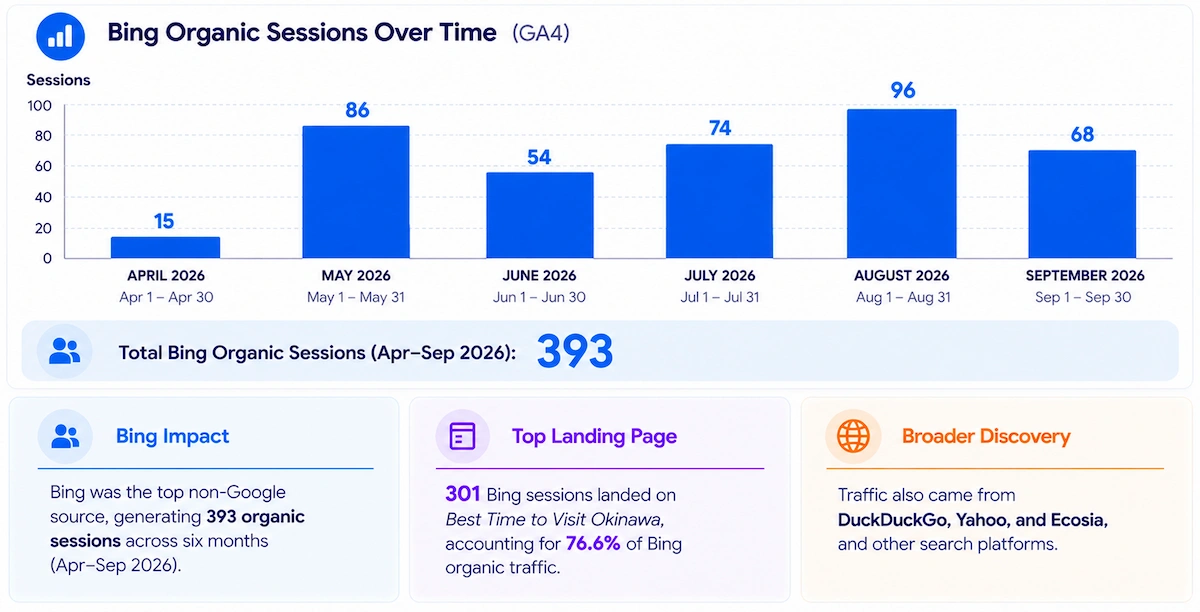
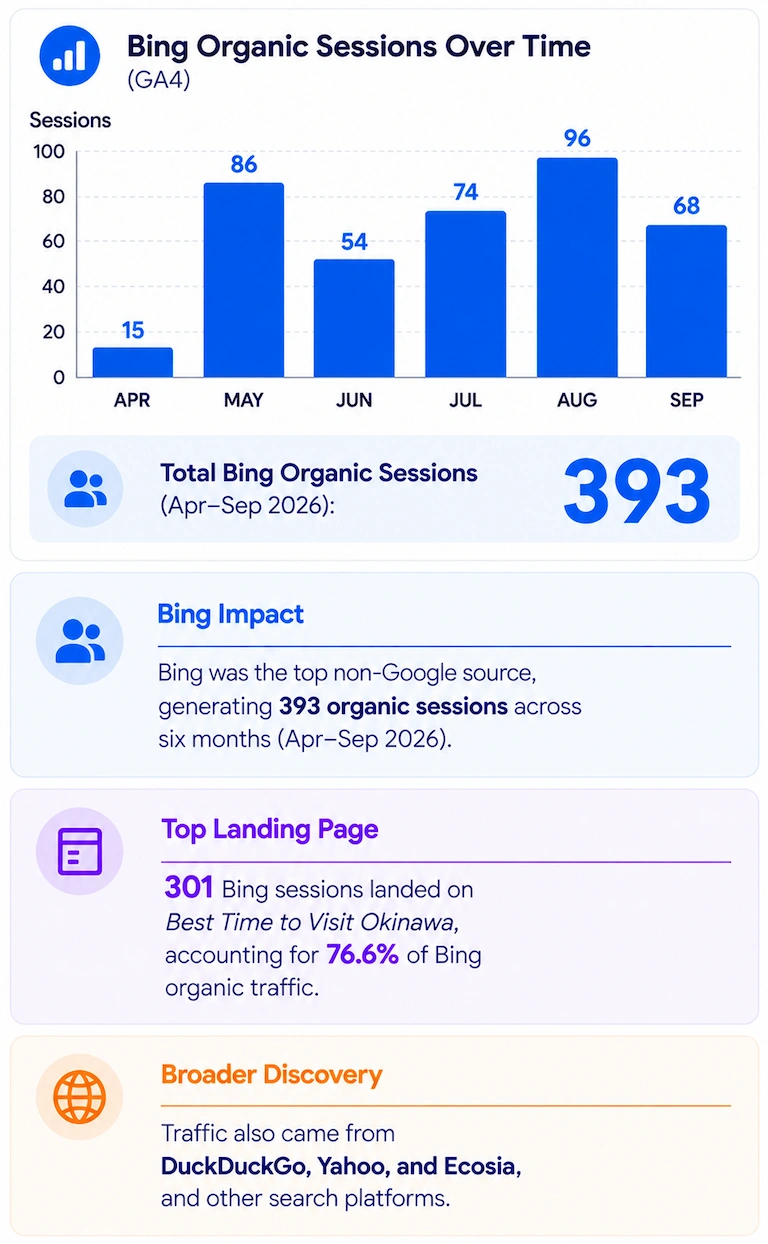
When I analyzed source/medium and landing page performance, I found that Bing consistently generated meaningful organic traffic from April through September. Across the six-month period, Bing accounted for 393 sessions, with 301 sessions landing on Best Time to Visit Okinawa.
In September, Bing remained the site’s largest organic traffic source with 68 sessions, followed by DuckDuckGo with 39, Yahoo with 10, Ecosia with 8, and Google with 6. Although Bing traffic declined from 96 sessions in August, its engagement rate improved from 59.38% to 66.18%, while average engagement time increased from 74.46 to 90.21 seconds.
This analysis reinforced the importance of combining Search Console with GA4 rather than evaluating SEO performance through a single platform.
Organic Search Beyond Google
Organic Search Highlights
- Bing generated 393 organic sessions from April through September, demonstrating sustained organic discovery beyond Google
- 301 Bing sessions landed on Best Time to Visit Okinawa, reinforcing it as the site’s strongest organic content asset
- In September, 47 of Bing’s 68 sessions (69.1%) landed on Best Time to Visit Okinawa
- Best Time to Visit Okinawa also attracted September organic traffic from DuckDuckGo, Yahoo, Ecosia, and Google, showing discovery across multiple search engines
- Okinawa Itinerary continued emerging as a secondary organic landing page, receiving 21 September organic sessions from Bing, DuckDuckGo, and Google
- Comparing GA4 with Search Console revealed a broader organic search story than Google data alone showed
Reviewing traffic sources alongside landing page performance showed that organic search visibility extended beyond Google. This reinforced the importance of using multiple analytics sources to understand how users discover and engage with content.
Strongest Content Asset
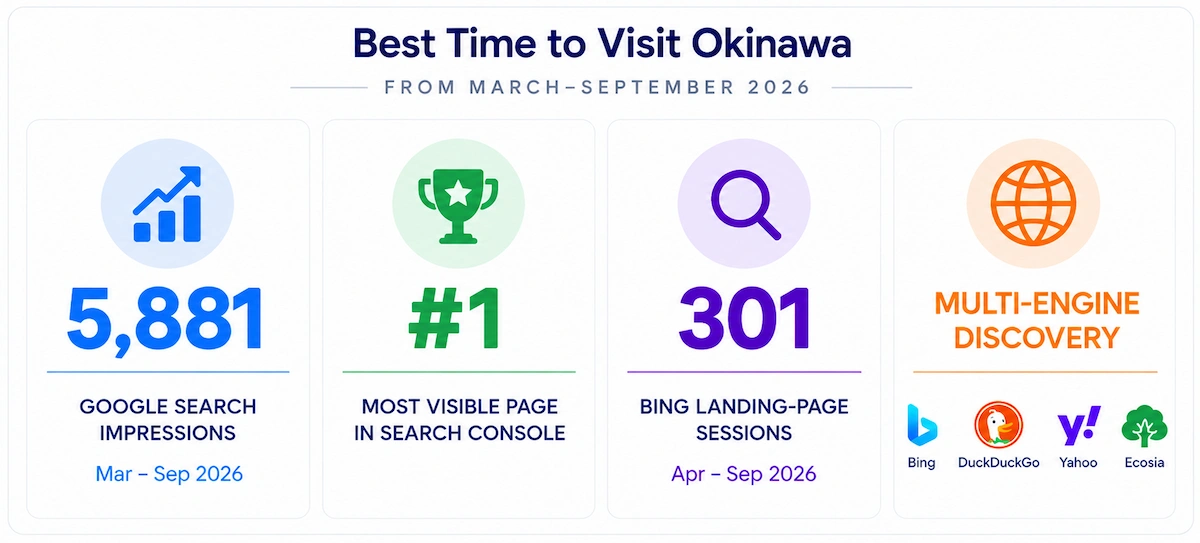
Among all published articles, Best Time to Visit Okinawa remained the site’s strongest-performing content asset. From March through September, the article generated 5,881 Google Search impressions, substantially more than any other page on the site.
GA4 reinforced the same pattern. The article consistently attracted organic visitors from multiple search engines, including Bing, DuckDuckGo, Yahoo, and Ecosia. From April through September, Bing alone generated 301 landing-page sessions to the article, accounting for 76.6% of all Bing organic sessions during the six-month period.
In September, the article continued leading the site with 848 Google Search impressions while its average position improved from 30.34 in August to 17.92. It also generated 122 GA4 landing-page sessions, with an average engagement time of 71.33 seconds.
Its performance also revealed how users were finding the content. Search Console associated the article with queries around travel timing, weather, seasonal planning, the best month to visit, and the worst time to visit Okinawa, helping identify opportunities for continued optimization.
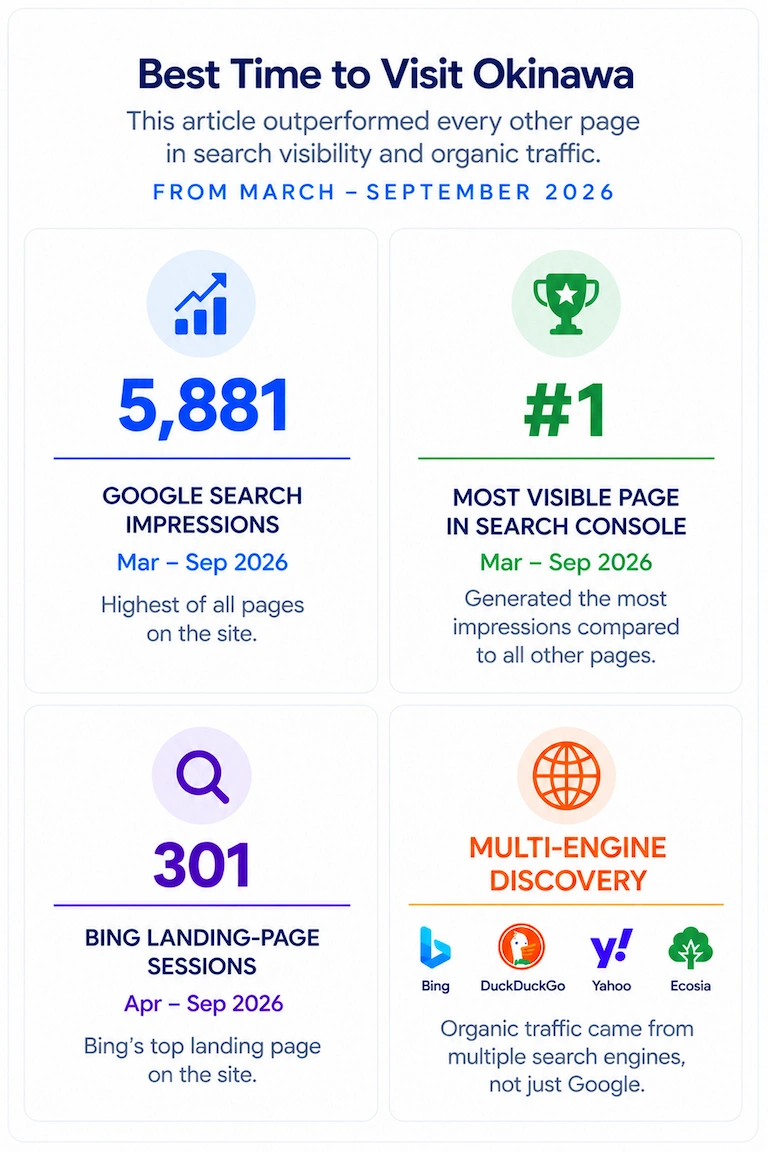
Analyzing this performance helped me better understand how SEO, content strategy, analytics, and user experience work together. Instead of relying only on initial keyword research or assumptions, I could use real performance data to evaluate content decisions, identify emerging search behavior, and guide future improvements.
Key Takeaway: Monitoring Google Search Console and Google Analytics 4 transformed SEO from a planning exercise into an ongoing optimization process. Real performance data helped validate content decisions, uncover new opportunities, and guide improvements to both search visibility and the user experience.
What I Learned From Building Okinawa Compass
By this point, the project had evolved from a simple SEO exercise into a live website generating search visibility, organic traffic, user engagement, and actionable insights.
Okinawa Compass began as a way to gain hands on SEO experience, but it became an opportunity to understand how SEO, content strategy, user experience, analytics, technical optimization, and WordPress management work together on a live website.
Throughout the project, I learned that successful content is not created by targeting keywords alone. Search intent, content organization, readability, internal linking, and user experience all influence how people discover and engage with information.
One of the most valuable lessons came from monitoring real world performance. Search Console and GA4 revealed insights that were not always obvious during the initial research process. Specific traveler questions sometimes generated more visibility than keyword volume estimates suggested, reinforcing the importance of validating assumptions with actual search and user behavior.
The project also gave me practical experience managing a live WordPress website, troubleshooting technical issues, improving performance and accessibility, and using analytics to guide ongoing decisions.
Search Visibility
- 5,881 Google impressions for the site’s strongest-performing article from March through September
- September generated 1,130 site wide impressions and 8 clicks
- Average position improved from 38.85 in August to 23.44 in September
- Search visibility continued expanding across travel timing, weather, seasonal planning, and other Okinawa travel topics
Organic Discovery
- Bing generated 393 organic sessions from April through September
- 301 Bing sessions landed on Best Time to Visit Okinawa, representing 76.6% of Bing organic traffic
- Organic discovery also came from DuckDuckGo, Yahoo, and Ecosia
- GA4 showed that visitors continued discovering and engaging with content beyond Google
Project Impact
- Built a growing Okinawa travel content cluster
- Created a scalable content strategy around the traveler journey
- Connected SEO decisions with real Search Console and GA4 data
- Established an ongoing process for research, publishing, measurement, and optimization
Key Lessons
- Search intent can reveal opportunities that keyword volume alone may miss
- Strong content organization can support both SEO and user experience
- Analytics can challenge assumptions and uncover new opportunities
- Technical SEO, accessibility, and performance all contribute to the overall user experience
- Managing a live WordPress website requires ongoing testing, troubleshooting, measurement, and iteration
Next Steps
Although the project established a strong foundation, Okinawa Compass continues to evolve. Future improvements will focus on expanding the content cluster, monitoring performance, and using analytics to guide ongoing optimization.
- Publish additional Okinawa travel content to expand topical coverage
- Continue monitoring Search Console and GA4 performance
- Strengthen internal linking as the content cluster grows
- Continue technical SEO and performance monitoring
- Use emerging search queries and analytics insights to guide future content updates
Final Takeaway: Okinawa Compass transformed my understanding of SEO from keyword research and rankings into an ongoing process of research, content strategy, technical optimization, measurement, and iteration. Managing a live website gave me hands on experience using real search and user data to make decisions that support both visibility and user experience. View the live Okinawa Compass website.
Explore More Work
Next Project